For Mauricio Casian, design begins long before he draws the first line. It begins with nature, time, and a deep understanding of the territory itself.
As an architect and designer, Casian studies the intelligence that millions of years of evolution have created. He then translates it into spaces, objects, and visual narratives that deepen our connection with the places we inhabit.
Curiosity, authenticity, and respect for the environment guide his creative process. He believes meaningful architecture should always maintain a strong relationship with its surroundings.
Rather than creating spaces that could exist anywhere, Casian designs places that feel inseparable from their context. His architecture observes, adapts, and ultimately belongs.
In this edition of People Who Inspire, Mauricio Casian reflects on creativity, Mexico, and the importance of place. He also explains why curiosity remains at the heart of everything he creates.
1. What is your purpose in life, and what inspires you every day?
Nature and time are the greatest designers that exist. Imagining the millions of years of evolution that have shaped life as we know it inspires me every day.
As an inhabitant of this planet, as well as an architect and designer, I want to learn from that accumulated intelligence. My purpose is to translate it into spaces, objects, and images that deepen our connection with the places we inhabit.
2. Tell us about what you do and the impact you hope to create through your work.
My work begins with the territory. I want each project to draw inspiration from its surroundings, adapt to them, and evolve naturally alongside them.
Through spaces, atmospheres, and visual narratives, I invite people to reconnect with the places they inhabit. At the same time, I seek to keep nature at the center of the experience.
3. How do you inspire others through your profession, business, art, or daily life?
True inspiration emerges when you allow others to understand and experience your work through your eyes.
I do not want to convince people to see the world as I do. Instead, I want to share how my perspective fuels my creativity and how that inspiration can take different forms.
4. What moment changed the course of your life?
As a child, I had many aspirations. At different times, I felt certain that I wanted to pursue science, botany, or art.
My answer changed constantly whenever people asked what I wanted to study. I felt passionate about many disciplines, but I did not understand how they could coexist within a single path.
Eventually, I discovered that architecture and design could bring all those interests together. I only needed to direct my professional development toward a broader, more interdisciplinary vision.
During university and my master’s degree, I had the opportunity to study abroad. I met students and professors from different countries and learned from their perspectives.
Comments such as “that does not belong here” or “that design does not respond to this climate” changed how I understood architecture.
I realized that every place has a unique identity. Conscious design begins with observing, understanding, and learning from the territory before intervening.
Since then, I have tried to create projects that respond to their context while celebrating its identity. Through my work, I also seek to strengthen the connection between people and the places they inhabit.
That experience taught me that the best architecture cannot exist anywhere in the world. It can only exist in the specific place for which it was created.
5. What has been the greatest challenge or adversity that has helped you grow?
One of my greatest challenges has been learning to trust my own vision.
When you begin developing a different idea, doubts inevitably appear. You wonder whether it makes sense, whether anyone understands it, or whether following a less conventional path is worthwhile. Sharing a personal way of seeing the world always requires a certain degree of vulnerability.
Over time, I learned that building a creative identity requires patience and trust. It is not about following trends or seeking immediate acceptance. It is about developing an authentic way of thinking and creating while giving it room to evolve.
Today, I see those doubts as a natural part of the creative process. They remind me that the most valuable ideas often need time to find their place.
6. What value would you never compromise, no matter the opportunity?
Authenticity.
Ideas, emotions, and creativity hold greater value when they come from genuine conviction rather than the need to meet expectations. I try to remain true to what inspires me, even when it leads me down a less conventional path.
With time, I have learned that authenticity does not mean refusing to change. It means allowing your ideas to evolve without losing their essence.
Ultimately, authenticity offers the most honest way to share who you are with the world.
7. Who has had the greatest influence on your life, and why?
It is difficult to choose just one person. At every stage of my life, someone has awakened a new curiosity in me.
Some people introduced me to science, while others brought me closer to art, design, or nature.
Looking back, I realize that no single voice has shaped me. Instead, the combined influence of many people has defined my perspective. Every conversation and experience has contributed to how I observe, think, and create today.
8. How has Mexico influenced your personal or professional life?
Mexico has deeply influenced how I see the world.
Its extraordinary diversity of landscapes, climates, cultures, and histories gives every region a distinct identity. I find it fascinating to see that richness reflected in nature and in how people have inhabited the territory over time.
Mexico City offers a clear example. Walking through its streets reveals layers of different civilizations intertwined like geological strata. The pre-Hispanic, colonial, and contemporary eras coexist to create a unique identity.
Seeing how time leaves its mark on a place has taught me an important lesson. Every creative process should begin by understanding, respecting, and celebrating the territory.
9. What is your favorite event, celebration, or tradition in Mexico, and why?
Día de Muertos is one of the Mexican traditions I value most.
The care, creativity, and participation behind this celebration inspire me. Every person, family, and community makes the tradition their own while preserving its essence.
During this time, we can appreciate the extraordinary richness of Mexican crafts, techniques, materials, and symbols. Each element carries meaning and memory.
Celebrations like this remind us who we are. Keeping them alive matters because they form part of the cultural identity that makes us unique.
10. What is your favorite place in Mexico to disconnect, recharge, and find inspiration?
I have always felt drawn to places with history, ancient cultures, archaeological sites, natural landscapes, and beaches.
These destinations awaken my curiosity. They invite me to imagine the stories, natural processes, and civilizations that have shaped them over time.
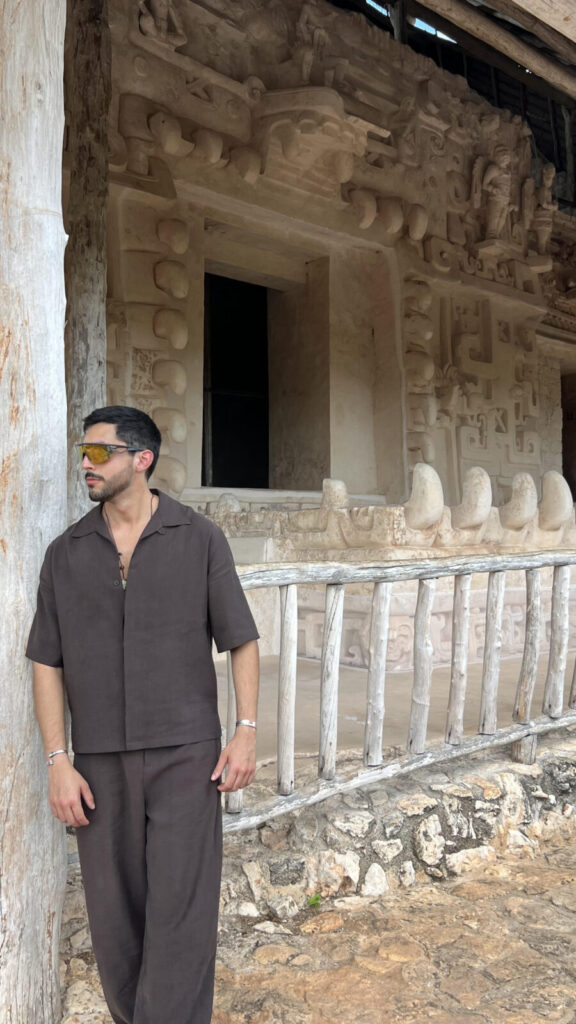
For this reason, the Yucatán Peninsula is one of my favorite places in Mexico. It brings together everything that inspires me: extraordinary natural beauty, a rich cultural heritage, and some of the country’s most remarkable landscapes.
The jungle, sea, and history coexist there in a unique way. Every time I return, I discover something new to observe and learn.
The Yucatán Peninsula reminds me that nature, history, and time always have something to teach us.
11. What advice would you give to someone who wants to live a more inspiring and purposeful life?
Keep curiosity alive.
The most inspiring people are not those who have all the answers. They are the ones who never stop asking questions.
Careful observation, constant learning, and the freedom to explore new interests can transform how you see the world.
Inspiration rarely appears on its own. It emerges when we cultivate curiosity and give ourselves time to look more closely.